
by Bill Wadge
 The Markup Macro Processor (MMP) is a text based macro system that uses a markup-like syntax, similar to (but much simpler than) XML.
by Bill Wadge
The Markup Macro Processor (MMP) is a text based macro system that uses a markup-like syntax, similar to (but much simpler than) XML.
By Bill Wadge
In the original Lucid language, the index domain (the set of natural numbers) was thought of as a set of time points-Lucid was designed as a temporal functional programming language.
Of course by choosing the set of natural numbers as the set of time points we are at the same time choosing a very simple model of time. In this model there is a first instant, and every instant has a unique successor. This is the bare minimum required to formulate conventional iterative constructs.
The intensional paradigm, however, has no commitment to any particular model of time or to any corresponding particular set of timepoints. This would suggest investigating temporal programming based on a different notion of time.
 For two years I was on the Canadian NSERC committee that reviewed individual grant applications. Fascinating.
After reading dozens of applications you can begin to see patterns emerging. I’m going to review some of these patterns, all but one of which I don’t recommend. No guarantees but I hope this helps.
In my research career I’ve discovered many things, including the secret of academic success (too late to help my own career). I’m going to share the secret with you.
Suppose you want the sum of the squares of the elements of a list congruent to 1 mod 3 you can write
reduce(lambda t,x t+x,map(square,filter(lambda x: x % 3 == 1,[1,2,3,4,5])))
Clear? As mud … (there are plenty of tutorials online about map, filter and reduce).
 In a companion post I give an overview of pyLucid, a version of Lucid close to that found in the Lucid book and implemented in Python. Here is an overview of the implementation.
 I was feeling energetic so I wrote a Lucid interpreter. I used Python and it turned out pretty well.
Lucid has been around for donkey’s years but for a long time there’s been no public implementation. Dataflow’s making a comeback and hopefully Lucid with it. I want it to be possible for interested people to run Lucid programs. Hence pyLucid.
How can you be in two places at once
When you’re not anywhere at all
— Firesign Theater
[Note: this is NOT original research. I just read the right book]
The famous double slit experiment is an unfathomably deep mystery, any number of people will tell you. People who should know. Experts.
Briefly, you shoot a beam of particles at a screen with vertical slits in it (maybe only two 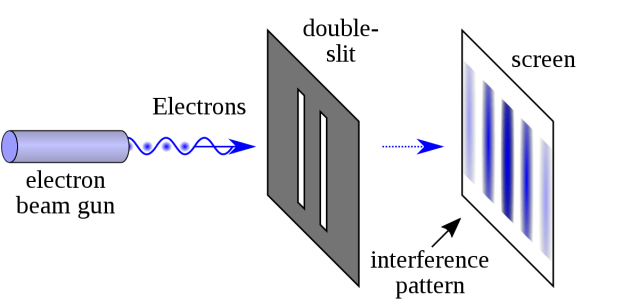 slits) and when they hit a detector screen on the other side you get a diffraction pattern. As if the beam were waves instead of particles. Even when you send one particle at a time.
The title of this post is a real headline from the Berkeley Barb (many years ago).

It made quite an impression on me at the time though it’s not clear what it means. I believe it was a discussion of a marijuana arrest at a sexual freedom league meeting. It sums up a lot of what was going on in Berkeley in those days.
Mathematicians discovered a new [whole] number. It’s between six and seven and is called “bleen”.
-George Carlin
When we’re talking about π, what are we talking about? What kind of object is it?
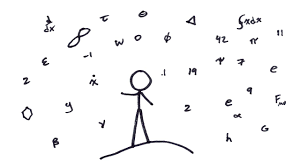 A number, your text book will tell you. Where is it? On the real line. Where is the real line and how long has it been around? It’s just there, and has been forever …
Your textbook may not answer these questions but philosophers have tried. Needless to say there is no consensus. They’ve come up with several answers, and in my humble opinion, all have something to offer, but all miss the mark.
I have an answer which you’ll be happy to hear I am going to share with you. Briefly, π and its friends live in our collective imagination. To be corny, in our hearts and minds.
 Bill Wadge's Blog